EIN Presswire and the “USA TODAY Network”: where a $149 release really appears
EIN Presswire's USA TODAY Network distribution doesn't put a press release on usatoday.com. We read three distribution reports and opened the pages: about 227 local newspaper sites, a paid-content banner, nofollow links, and one or two copies shown by Google. What that's worth, and how usatoday.com itself is bought.

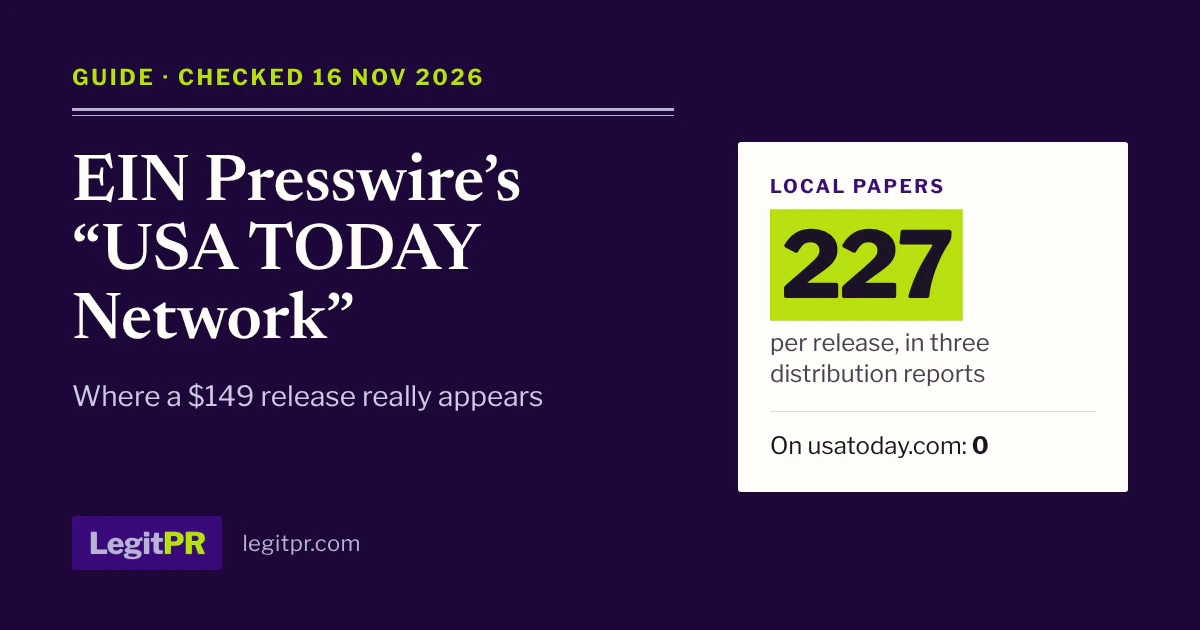
Not on usatoday.com. EIN Presswire's packages, from $149, include the “USA TODAY Network”, and in the three distribution reports we read that meant a page in the press-release section of about 227 local newspaper sites, from the Milwaukee Journal Sentinel to The Des Moines Register. usatoday.com wasn't in any of them. Each local page sits under a banner saying it's paid press release content, its links are nofollow, and Google treats the copies as duplicates: for the exact headline it showed one or two. That's a lot of pages for $149. It isn't USA Today.
The phrase is on EIN Presswire's pricing page, next to AP News and Nexstar, and it's easy to read it as “my release will be on USA Today”. We wanted to know what it produces. So we read what EIN says, counted what its own distribution reports list, opened the pages, and looked at what Google does with them.
What EIN Presswire says
On 16 November 2026 the pricing page said all packages include AP News, Nexstar Media Group and the USA TODAY Network. The line for the network adds that releases are distributed to it “based on relevance only”. It gives no number of sites and no list, and it doesn't name usatoday.com.
The network was announced in EIN's newsletter of 18 December 2025 as 280 publications in 43 states and 220 local markets, with a promise that the content would be indexed by Google, Google News and AI systems. The plans it comes with: $149 for one release of up to 700 words with one image, $499 for five (six while a limited-time offer runs) and $999 for fifteen, each valid for a year.
Nothing in that wording is false. EIN never says usatoday.com. It's the reader who supplies the rest.
What the USA TODAY Network is
USA TODAY Co. is the company that was called Gannett until November 2025. Its network is the national title plus its local newspapers, a couple of hundred of them. Press releases don't go into those papers' news pages. In June 2025 the company signed a deal with XPR Media to distribute press releases on usatoday.com and across the local sites, and its press-release sections are where a paid release lands, at an address such as jsonline.com/press-release/story/ followed by a number and the headline.
XPR's terms of service say it works with agencies and doesn't serve end customers, so every release in those sections arrives through a wire, an agency or a marketplace. EIN Presswire is one of the wires, for the local sites.
What three distribution reports list
EIN gives each customer a distribution report: a list of site names and addresses, one row per placement. Three customers had left theirs open to the public, and a web search found them: a travel company's product launch issued on 7 March 2026, a paving contractor's seasonal announcement for one metro area (13 March) and an online publication's report (14 April). We sorted every row.
| Rows that point to | 7 March | 13 March | 14 April |
|---|---|---|---|
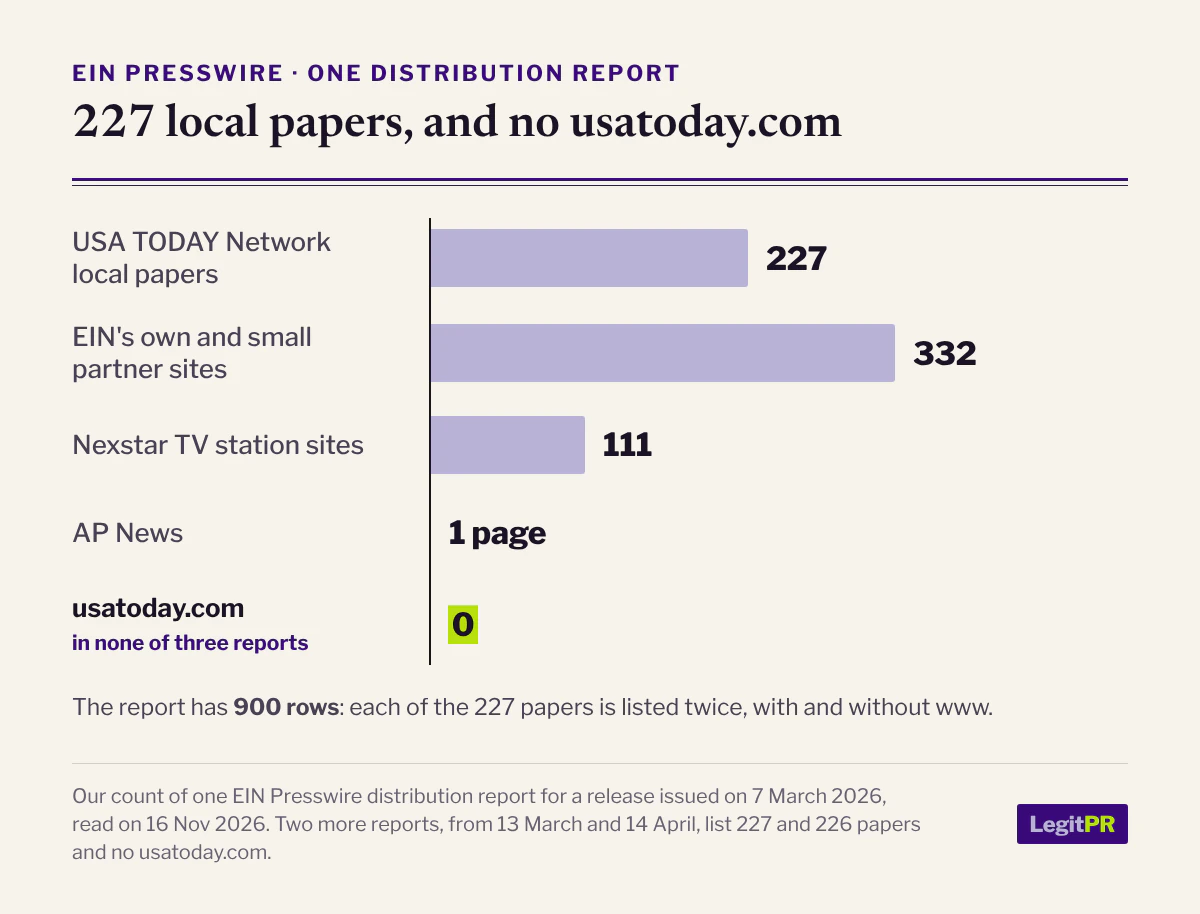
| USA TODAY Network local sites: addresses | 230 | 233 | 226 |
| USA TODAY Network local sites: different papers | 227 | 227 | 226 |
| usatoday.com | 0 | 0 | 0 |
| Nexstar TV station sites | 111 | 111 | 110 |
| AP News | 1 page | 1 page | 1 page |
| Other sites: EIN's own publications and small partner sites | 332 | 303 | 240 |
| All rows in the report | 900 | 903 | 585 |
- usatoday.com isn't there. Not in any of the three, under any address.
- “Relevance” came out as nearly everything. A paving contractor serving one metro area in Minnesota was placed on the same 227 papers as the travel company, from Cape Cod to California. Of the 235 addresses that appear across the three reports, 221 appear in all of them.
- Rows aren't placements. In two of the reports every network paper is listed twice, with and without www, which is how 227 papers become 447 rows. Count sites, not rows.
- The addresses show who runs it. A few rows point to hosts ending in xpr-gannett.com, one per paper.
The papers are the ones you'd expect, large and small. The Arizona Republic, the Detroit Free Press, The Indianapolis Star, the Milwaukee Journal Sentinel, The Tennessean, The Columbus Dispatch, The Cincinnati Enquirer, The Des Moines Register, The Courier-Journal, The Oklahoman and The Palm Beach Post were in all three reports, next to weeklies such as the Gonzales Weekly Citizen.
The other placements have address patterns of their own, which helps when you read a report. Nexstar station sites publish under business/press-releases/ein-presswire on each station's domain, and the AP News page sits at apnews.com/press-release/ein-presswire-newsmatics.
What the page looks like on a local site
We opened the April release on the Milwaukee Journal Sentinel's site on 16 November 2026. It was still there seven months on, and this is what a network placement is:
- An address in the paper's press-release section. jsonline.com/press-release/story/, a number and the headline. It went up the morning after the release was issued.
- A banner on every page. It says the page holds press release content distributed by XPR Media, that the network's editorial and news staff weren't involved, and that the placement is part of a paid service. Under the headline, a byline: Distributed by EIN Presswire.
- Open to Google. The page is set to index, follow, and its canonical tag points to itself.
- Nofollow links. All 11 outbound links carried rel=nofollow.
- The same system as usatoday.com. The national section shows the same banner, and both sections' feed addresses sit on xpr-gannett.com.
That afternoon, 12 of the 18 newest releases we opened in the Journal Sentinel's section carried EIN's byline. On usatoday.com/press-release, none of the 16 newest did.
What Google does with 227 copies
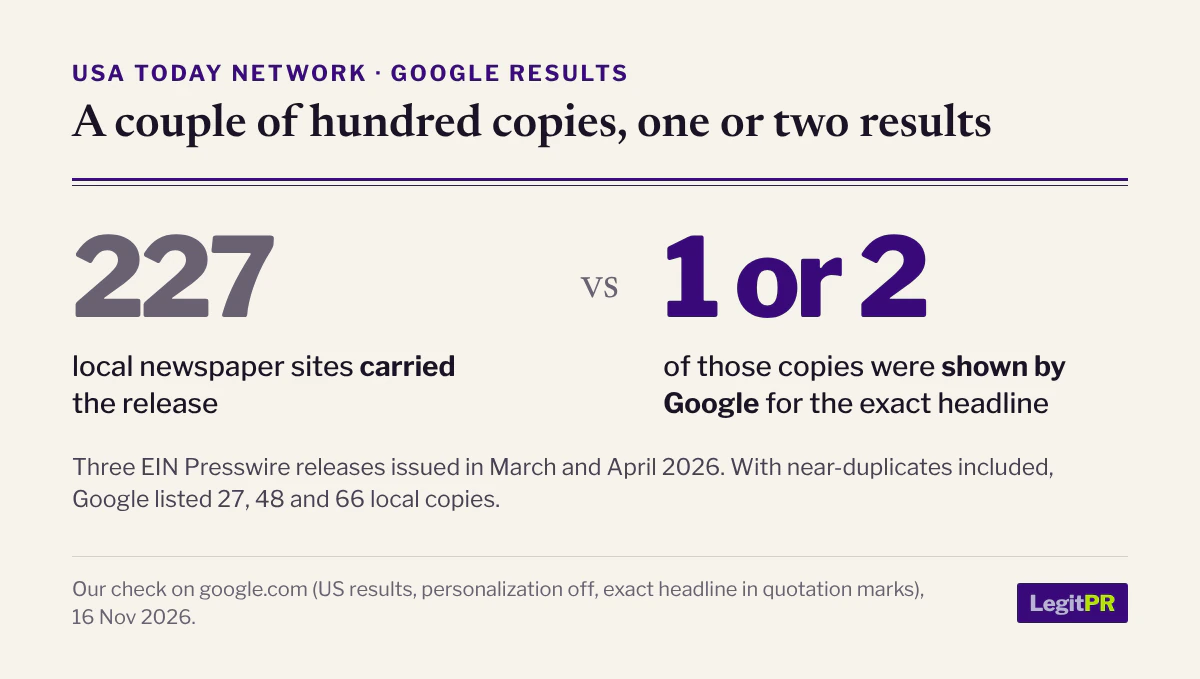
Every copy names itself as the original, so Google has to choose. On 16 November 2026 we searched each of the three headlines in quotation marks on google.com, with US results and personalization off, first as Google shows them and then with the near-duplicates it leaves out.
| Release | Local papers that carried it | Local copies Google showed | Local copies listed with duplicates included |
|---|---|---|---|
| 7 March 2026 | 227 | 2 | 48 |
| 13 March 2026 | 227 | 1 | 66 |
| 14 April 2026 | 226 | 2 | 27 |
So the network gives you a couple of hundred pages and Google gives you one or two results. Which paper gets shown isn't yours to choose: in our searches it was The Columbus Dispatch twice, and the Ventura County Star, the Clarion Ledger and The Des Moines Register once each. Most of the copies weren't listed at all, even with duplicates included.
What that's worth
Taken for what it is, the $149 is good value. One AP News page, about 110 TV station sites and about 227 newspaper sites is a long list for the price, and the page we went back to was still up seven months later. If a customer or a lender in Des Moines searches your announcement, a page on the Register's domain may be what they find.
Three limits decide whether it's what you need:
- It's a labeled paid page, not coverage. The banner says so at the top. Don't describe it to anyone as being featured in a newspaper.
- It adds one or two search results, not 227. And the AP News page isn't one of them: AP keeps its press-release pages out of Google, as we found when we checked each outlet's links and index tags.
- Some categories can't use it. EIN's editorial guidelines exclude health supplement content, among others.
If you want usatoday.com itself
The national section is the same kind of page: the same banner, nofollow links, open to Google. What changes is the domain in the address, and that the release exists there once, not as one copy among a couple of hundred. In October 2026 a customer's release in that section, with its target search phrase at the start of the headline, was the first result on Google for that phrase two days after it went live; the details and their limits are in how to get published on USA Today.
Because XPR sells only to agencies, usatoday.com reaches you through a reseller or a marketplace, and prices for the same page differ a lot from one seller to the next. Whoever you buy from, ask for a live sample whose address starts with usatoday.com/press-release/story/.
Before you buy either
- Ask the seller for a recent distribution report, and count sites, not rows.
- Search the report for the address you care about: usatoday.com/press-release/, or the local paper you want.
- Open a few of the links a week later, and again a month later.
- Search your exact headline in quotation marks to see which copy Google shows.
- Leave the links out of the sum. They are nofollow on every page we opened.
A press release page on usatoday.com through LegitPR is $125 for one release, $449 for five or $899 for ten. We adapt the release you already have, you approve the final version before you pay, and it goes live about a day after approval and payment. A release that isn't published is refunded under our refund policy. The listing is on the USA Today page.
Does EIN Presswire publish your press release on USA Today?
Not on usatoday.com. Its packages include the USA TODAY Network, and in the three distribution reports we read that meant the press-release sections of about 227 local newspaper sites, such as the Milwaukee Journal Sentinel and The Des Moines Register. usatoday.com was in none of the reports, and none of the 16 newest releases in usatoday.com's own section carried EIN's byline when we looked on 16 November 2026.
What is the USA TODAY Network?
The national title USA TODAY together with the local newspapers of USA TODAY Co., the company that was called Gannett until November 2025. Press releases on those sites sit in a separate section run with XPR Media, under a banner saying the newsroom wasn't involved and the placement is paid.
How many USA TODAY Network sites does an EIN Presswire release appear on?
In the three reports we read, from March and April 2026: 230, 233 and 226 addresses, which is 226 or 227 different papers once second addresses of the same paper are taken out. Across the three reports there were 235 addresses, and 221 of them appeared every time.
Are the local USA TODAY Network pages indexed by Google?
They are open to Google: the pages we opened were set to index, follow, each with a canonical tag pointing to itself. But they are copies of each other. When we searched the exact headlines on 16 November 2026, Google showed one or two local copies each time and listed 27 to 66 only when asked to include near-duplicates.
Do the links in those pages help SEO?
No. Every outbound link on the pages we opened carried rel=nofollow, the same as in usatoday.com's own press-release section. Buy the placement for the pages and the names on them, not for links.
Is EIN Presswire's $149 release worth it?
For reach by count, yes: one AP News page, about 110 Nexstar TV station sites and about 227 local newspaper sites for $149 is hard to match. It isn't a way onto usatoday.com, Google shows only one or two of the copies, and EIN doesn't take health supplement releases.
How do you get a press release on usatoday.com itself?
Through an agency or marketplace that works with XPR Media, which runs the section and doesn't sell to end customers. Prices vary by seller; ours is $125 for one release. Ask any seller for a live sample whose address starts with usatoday.com/press-release/.
Read next

Ready to be published where it counts?
Pick your publications, upload a draft and have verifiable coverage live within days.
No subscriptions · Live links · Refund if not published